How to draw your garden site survey plan to scale [part 2]

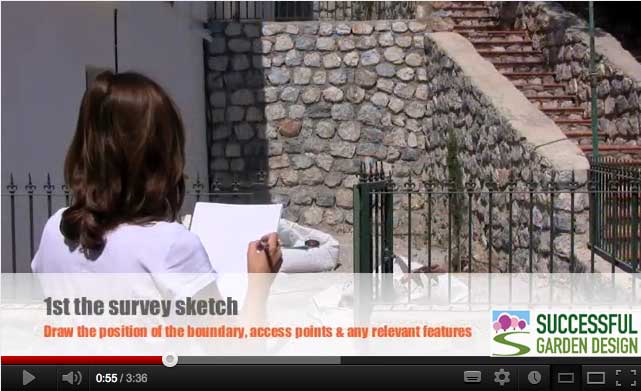
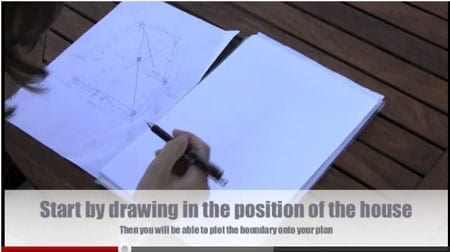
In this video we take a look at how to turn all those measurements you took from the last video and translate them into a usable drawing.

Why bother, though?

I mean, really, who wants to spend any of their free time trying to get a garden survey onto a bit of paper?

Answer: anyone who really wants to do a good job creating their dream garden.

The rest of the population will be too lazy and won’t care enough. That’s not you though, is it? If it were, you probably wouldn’t be spending time to learn how to create a great garden if you didn’t really want to achieve one, would you? Unless of course the garden design fairies have hidden a hypnotic message into the YouTube efforts (seek help if you think that’s the case).

To get yourself though this slightly dull but VITAL part of creating a beautiful garden – just envisage your dream garden a few months from now. Imagine sitting in it on a lovely summer’s evening sipping your favourite beverage – surely that was worth an hour spent measuring your garden and drawing up your survey? If it wasn’t, you didn’t imagine a beautiful enough garden – try again!

As you’ll have seen in the video, the shape of the freehand, rough survey sketch and the finished drawing is significantly different. THIS ALWAYS happens – that is why you mustn’t guess what shape and size your garden is! If you haven’t already, read the tapemeasureaphobia post, you will see why this is SO important to do.

Next week we get onto the fun part – the design. You’ll see exactly how the process is done, from beginning to end – plenty of top designer trade secrets coming your way!


  Copyright protected by Digiprove © 2010

How to measure your garden [part 1]

YouTube Preview Image

The video above is for anyone suffering from tapemeasureaphobia!

Yes, we finally have the first of the infamous garden in Spain video series up and running…. hoorah – well not quite hoorah, more horror. I don’t know what is worse, being in front of the camera to do these (yes I do feel like someone auditioning for a bad reality tv series) or the horrific editing process where I have to sit through hours of gaffs!

So why would I put myself through this horror (other than to make my family and friends cry with laughter)?

Because it is REALLY important you measure your garden if you are going to design it well. The survey is the first step to successfully designing your garden, without it you won’t succeed. Yes the reality is as harsh as that…

The other aim of the video is to show you, there isn’t anything to be afraid of. No rocket science involved, no sorcery, just a tape measure and a sheet or two of paper.

So watch the video, laugh if you have to but most importantly get out there and survey your garden!

In the next video in part 2 of this 4 part series – How to draw up your garden survey to scale (it really isn’t *that* scary).

Leave a comment if the video has been helpful, or if you have a question you would like answered on garden surveying.

If you would like another FREE lesson, download it from the Beginner’s Successful Garden Design Course (sample lesson is halfway down page)


How to visualise your garden design (especially if you can’t visualise!)

visualise

I was chatting with Alison Kerr from Loving Nature’s Garden the other day about how tough it can be to visualise how the design changes you want to make in the garden will look.

The sentence “I just can’t visualise” has been muttered into my little ears more times than I care to remember from my design clients. But Alison’s remark got me thinking….

How do you visualise a finished garden design?

It’s coming close to the launch of the Beginner’s Garden Design Course for homeowners and I have had to think back a lot in the past months about what problems I encountered when I first started to design and how I got past those problems. One thing I hadn’t really thought about, though, was visualisation…

Now that I have taken the time to stop and think about it, something quite shocking occurred to me. I couldn’t visualise at ALL when I first started. More shocking than that, I’ve only really started to be able to ‘see’ how something will look in the last 5 or 6 years!

So how on earth did I manage to be a successful, professional, garden designer if I couldn’t visualise for the life of me?

That is an excellent question – one I was very surprised to be asking myself! When I think back, it all comes down to the way I was taught at college. We started and finished the whole design process on paper.

Looking at your design on a plan, will help you see what works and what doesn’t without the need to visualise.

To explain that further – garden design is about shape, proportion and movement through the garden. It’s much easier to see that from above (the plan view) than it is whilst you are standing in the garden.

One of the most important things I learnt is – if it works on paper it will work in the garden. Because I was working mostly with shapes to get the key design principles working and because I understood how the design principles worked, I didn’t need to visualise.

I do remember when my first few garden designs were built, how anxious I felt during the process. They were right though – it really does work in real life if it does on paper.

My cheat

However, I’m not totally comfortable to just rely on the plan, I like to know that something will definitely work. So the trick I use when I have finished the rough design is to do a little 3D sketch of the layout.

Before you tell me you can’t draw to save your life – neither can I actually. My perspective sketches look like I’ve drawn them standing on a roof, so they are not much better than the plan view!

Here comes the cunning cheating part…. Take a photograph of your garden (several if it is large – join them together to form a panoramic view). And trace over it and incorporate the shape of your design as best you can. It will help you to visualise how your design will look. And most importantly, you will have the correct perspective and scale thanks to the photograph!

Sketching1

Kaye-sketches_0001If you are feeling more adventurous than that, you could make a clay model or even a cardboard one – here’s one I made for a client overseas (scroll to end of photos to see it). It took ages and I’ve vowed never, ever to do it again but it was effective – amazing what you can do with a shoe box, some cardboard, plastic plants & a few fairy lights!

The sketches and models are for reassurance but they aren’t totally necessary if you draw your garden to scale and work on a proper plan. I’ll be doing a series of how to measure and draw up a plan to scale, coming soon on the blog (yes the infamous set in Spain videos will be coming soon!).

In the meantime if you want to learn more and want a FREE report on avoiding 5 BIG garden design mistakes? Then just sign up to the newsletter to receive your FREE report!

  Copyright protected by Digiprove © 2010

Do you suffer from the phobia that affects new gardeners?

Jigsaw1There is a worrying condition that threatens to thwart good garden design…

The condition is called tapemeasureaphobia. A bit of a mouthful to say, but it’s no laughing matter, there are some fairly serious consequences to the condition that doesn’t always become apparent immediately…

In layman’s terms this affliction, is simply known as an extreme fear of tape measures, resulting in sufferers being unable to measure their garden!  I once suffered from the affliction myself. The first garden I ever designed BEFORE I was properly trained (my parents garden) I didn’t measure… I did put a LOT of time and effort into the design though… shame it didn’t fit when we came to build it!! Now before you start thinking bad things about me, I was only 19 and I had read, nearly, one whole book, on garden design and had skipped the bit about measuring as it looked really dull, boring and not that important!

I wasn’t wrong with the dull and boring part – it is. BUT I was WRONG about it not being important!

Why is measuring the garden so important? Won’t an educated guess do?

In a really well designed garden,  the design works as a whole entity – every aspect is interlinked, even if it is divided into different sections. If you change one part of the design it has a knock on effect with everything else. A bit like doing a jigsaw puzzle – you can’t fiddle with one bit and have it not effect everything around it!

So what have jigsaws got to do with measuring a garden?!

I’m getting to that bit! Imagine you are building your jigsaw in a frame – the frame is solid and has fixed dimensions (pretty much like your garden fence or boundary). Now for argument’s sake, you have guessed that the frame is square and of a certain size… bear with me… and you have made a jigsaw according to the size you THINK the frame is… Now imagine trying to get that jigsaw to fit in that existing frame!

Even if you are REALLY good at guessing, what do you think the odds are that your jigsaw will fit perfectly into that frame are? Obviously you can’t alter the frame to make the jigsaw fit, so your only option is to make the jigsaw fit the frame….and that of course will affect the overall look, shape and feel of it.

How easy do you think that will be?

The honest answer is it depends on the design, some designs are more robust than others and can take a bit of altering without any major casualties. But you will most likely find (like I did with my first garden design) that the garden wasn’t quite the shape and size you thought it was. Therefore your design and all that TIME you spent on it has to be re-done, on site! NO easy task, not even for a professional garden designer!

If you are going to spend the time and effort designing your garden (and I really hope you are)… Trust me, trust me, trust me on this one – you really do need to measure your garden properly BEFORE you design it! If you want to learn exactly how to survey there is a free garden video tutorial on measuring which is ideal for easy shape gardens or there is a full survey course.

And if you’ve had any measuring disasters you’re brave enough to share – please tell us about your experiences in the comments!

If you would like to learn more about avoiding BIG garden design errors please sign up to the Successful Garden Design Newsletter and receive a FREE 5-part report on what to avoid! Your email address will NOT be passed onto anyone else and you will NOT be spammed!

FREE REPORT!

FREE REPORT!


Get your FREE e-report & newsletter!
Email:

  Copyright protected by Digiprove © 2010