
 We’ve arrived at the dreaded Friday the 13th, a date that makes plenty of people pause.
But here’s the thing: 13 wasn’t always seen as “unlucky.” In many older ways of thinking, 13 is simply the number that shows up when you pay attention to natural rhythms rather than tidy human systems.

Why 13 became “unlucky”
The modern superstition is basically a mash-up ideas:
- Friday gained a gloomy reputation in parts of Christian Europe because it was associated with sorrow and execution (Good Friday being the obvious reference point).
-
Norse Mythology: In a tale from Valhalla, the trickster god Loki crashed a banquet as the 13th guest. He orchestrated the death of Balder, the god of light and joy, making the number 13 symbolise betrayal and death.
-
Historical Events: On Friday, October 13, 1307, King Philip IV of France ordered the arrest of the Knights Templar, leading to their torture and execution.
- Add the Last Supper tradition (13 at the table, with betrayal following) and you get a sticky narrative!
And no doubt there are more! When put together, you get a date that’s easy to dramatise, repeat, and remember, which is why it’s been amplified by mainstream culture.
13 became the “disruptor” because so many cultural systems are built around 12 – 12 months, 12 zodiac signs, 12 tribes, 12 apostles. Twelve feels complete. Thirteen feels like the extra one that breaks the pattern.
But that’s not the only way to look at 13…
The older view: 13 as a growth number
The older “wisdom view” of 13 is often the opposite: 13 as transformation, completion-plus-one, and renewal. In older lunar timekeeping, a solar year contains roughly 13 lunar cycles, so 13 can symbolise the full rhythm of life-death-life rather than “bad luck.”
You also see 13 linked with initiation: after a stable cycle (the 12), the 13th step is the threshold where you change level – uncomfortable, yes, but potentially fortunate because it’s where growth happens. In that sense, 13 isn’t “chaos,” it’s the principle of change: the number that won’t let a system stay static.
If 12 is the closed circle, 13 is the step beyond it, the point where a system has to expand, adapt, or evolve.
In other words: 13 isn’t “bad luck.” It’s change.
A calendar that fits nature (and turtles)
In The Mystery School Adventures, my character Emelia gets excited about something she calls “Turtle Time.” The idea is simple: what if we organised the year around a more regular rhythm, like the Kodak company did back in the day, when they went over to using the International Calendar?
- A year divided into 13 months
- Each month having 28 days
- Plus a “spare day” to reach 365
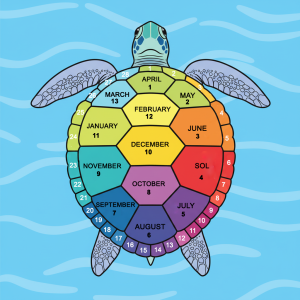
- 13 larger segments
- 28 smaller segments around the edge
The “missing” 13th zodiac sign
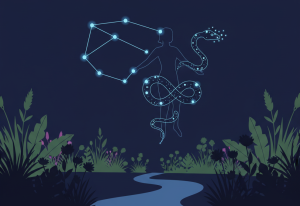 Astrologers traditionally work with 12 zodiac signs, but astronomers note that the sun’s path crosses 13 constellations. The one that is left out of the zodiac is Ophiuchus (the Serpent Bearer), sitting between Scorpio and Sagittarius.
The reason it’s ignored is practical: twelve divides neatly. Thirteen doesn’t.
What this has to do with garden design
And reality is rarely “perfectly divisible.” Real gardens are:
- Irregular shapes
- Slopes
- Sun & shade
- Existing trees, drains, walls, neighbours
- Budgets, time limits, and changing needs

So here’s the garden-design translation of 13:
The “13th step” is where the garden becomes yours…
Most people can get through the steps of planning (especially if they follow my step-by-step garden design courses): measure, sketch, list needs, choose a style, pick materials. But there’s often a moment where you have to stop looking for the perfect answer and make a real decision, committing to a layout, choosing the first plants, starting the build.
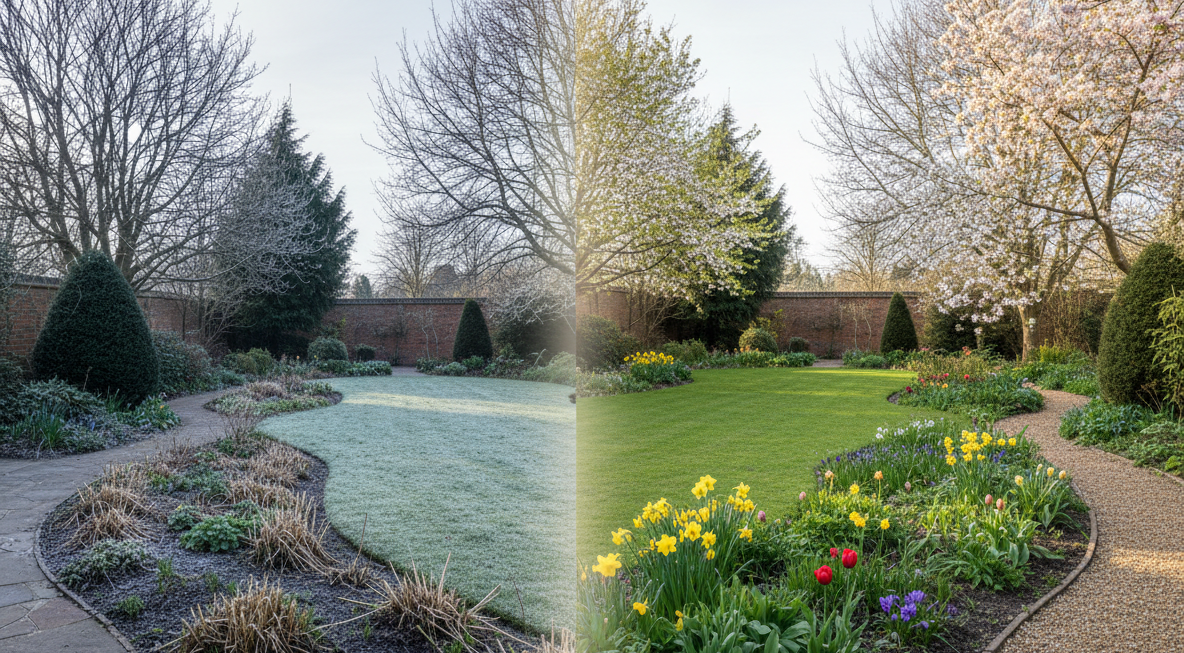
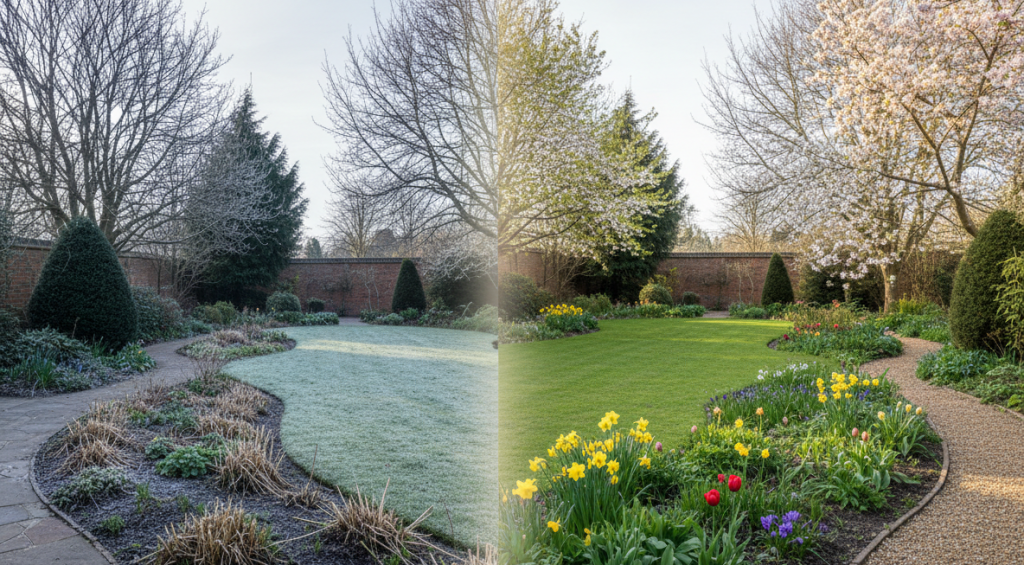
AI can be quite useful when it comes to helping you visualise how your finished garden will look (which I covered in the previous post & demonstrated in the two images below) but it can’t design for you (successfully!).

That moment can feel uncomfortable… and it’s exactly where progress happens…

Nature doesn’t do neat boxes – it does cycles
- Temperature shifts
- Day length
- Soil warmth
- Rainfall
- Nutrients
If you’ve ever been caught out by a sudden heatwave, a late frost, or a wet spring, you already know: nature doesn’t care what the date says.
Thirteen is a useful symbol here – it reminds us to design for rhythm and resilience, not rigid perfection…
“Unlucky” is often just “unfamiliar”
- A path that curves instead of running straight
- A tree that blocks a view but creates privacy
- A weird angle fence which creates design opportunities that square or rectangular gardens don’t
The “extra” element, the one that breaks the tidy pattern, is often what turns a garden from generic to great.
A better Friday the 13th thought…
So if you catch yourself feeling a bit superstitious, here’s a more useful interpretation:
Friday the 13th isn’t unlucky – it’s a reminder that growth doesn’t happen inside perfect systems.
And if 12 is the neat plan on paper, 13 is the moment you step outside and start making it real.
If you’d like to go deeper…
If you enjoy this kind of “natural rhythm” thinking (without losing your grip on practical reality), keep an eye out for Mystery School Adventures – it’s been a surprisingly fun way to explore the stories we tell ourselves about time, nature, and how the world works. Though, I must warn you, it will be a while as I’m currently only writing chapter 5!


4 replies to "Gardening Friday the 13th: Unlucky, or a Natural Rhythm Gardens Understand?"
Rachel…I attended your garden design course and followed you since 2022. And I just loved your Friday the 13th post! The day never treated me badly, so I do not fear it. And the change it personifies is indeed happening right now. Please continue to share your love of nature and creativity..it is THE place where healing occurs
Thank you, Sarie – I do intend to do a few more articles like these, so I’m glad you liked it! Thanks for letting me know :o)
What a wonderful uplifting article on a sunny but rainy day here in Cornwall, incredible double rainbow though.
I needed it today, just got digging in our garden after watching your video and completing the design wizard and our neighbours decided to replace their fence so loads of disruption to our plan. I can always read your articles and they keep me going. And keep me focused. It can seem daunting but I’m doing it in the 3 stages now and it’s easier to get my head around it as a complete beginner. Thank you as always Rachel x
Ah thank you, Hazel! I’m so glad it was helpful :o)
Good luck with your garden and keep us posted with how it turns out!
R x